8 Oct 2026
Project partners presented work from AI-PROGNOSIS during the five-day congress in Seoul
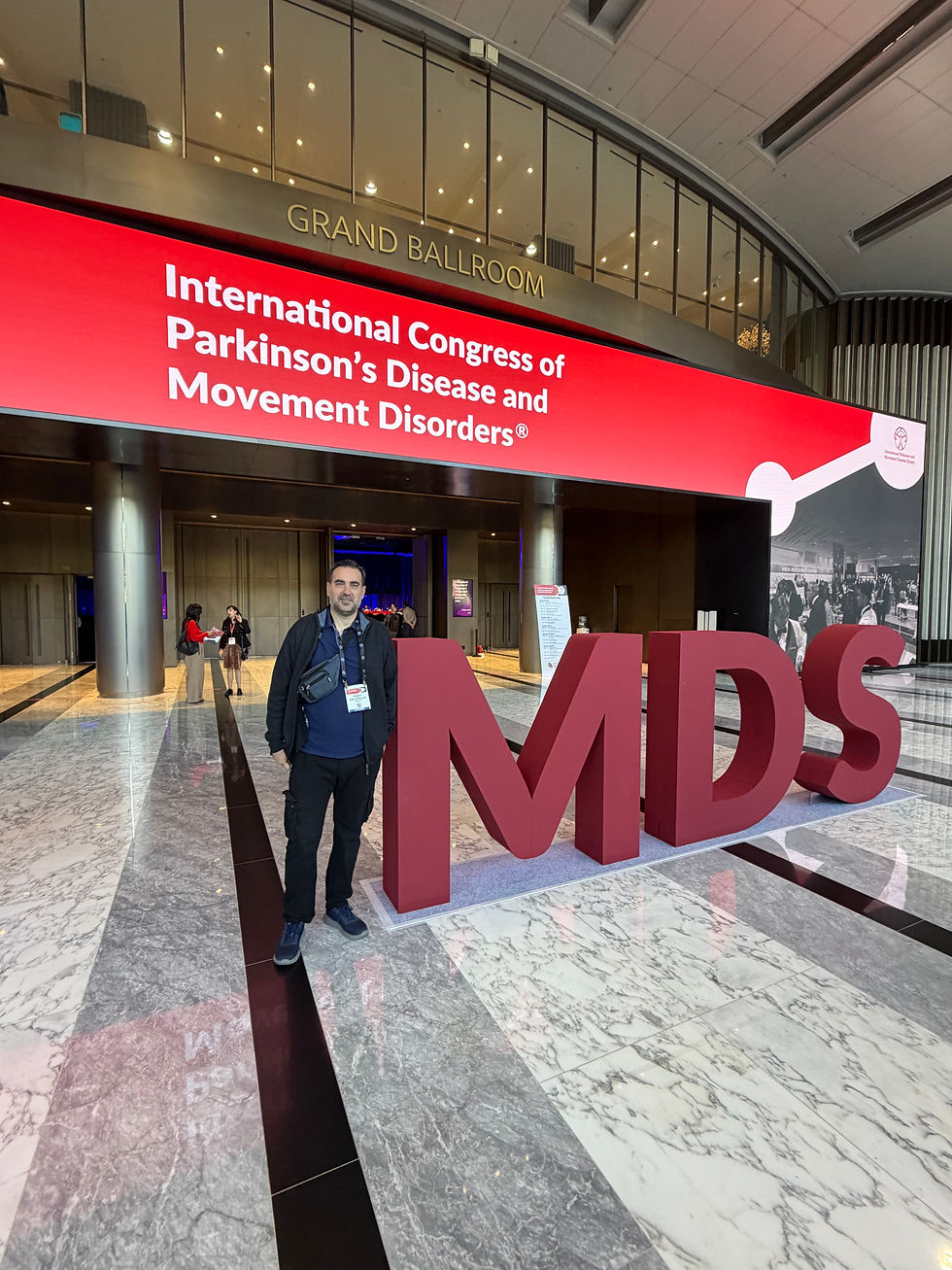
The AI-PROGNOSIS project was represented at the International Congress of Parkinson’s Disease and Movement Disorders®, held on 4–8 October 2026 in Seoul, Korea.
Across the five-day congress, project partners presented work from different areas of AI-PROGNOSIS:
Eduardo de Pablo-Fernández (Queen Mary University of London) presented the poster “An artificial intelligence-based model to predict Parkinson’s disease risk: The AI-PRA study”, providing an overview of the AI-PRA study, which aims to create a proof of concept for the AI-based Parkinson’s disease detection model the project is developing.
Ioannis Gerasimou (Aristotle University of Thessaloniki) presented the poster “Differences in Sleep and Activity Digital Phenotypes from Wrist Accelerometry in Parkinson’s Disease, At-Risk Individuals, and Healthy Controls”, providing initial evidence on wearable-based sleep and activity metrics that could be used for screening persons at risk of Parkinson’s disease.
Kosmas Dimitropoulos (Centre for Research & Technology Hellas – CERTH) presented the poster “Smartphone video derived digital motor phenotypes of MDS UPDRS-related tasks via a comprehensive motor function test”, providing an overview of the initial results from the smartphone camera-based body-tracking approach developed by the project for the assessment of motor function in Parkinson’s disease.
Björn Falkenburger (Technische Universität Dresden) presented the work “Smartwatch actigraphy for detection of REM sleep behavior disorder: the dBM-DEV study”, providing an overview of the dBM-DEV study and its findings on the use of smartwatch-captured motion data to detect REM sleep behaviour disorder, a key non-motor symptom of Parkinson’s disease, under free-living conditions.
Natalia del Campo (CHU de Toulouse) presented the poster “AI-based Progression and Medication Response Prediction in Parkinson’s Disease: the AI-PMP Study Protocol”, providing an overview of the AI-PMP study, which aims to create a proof of concept for the AI-based Parkinson’s disease progression and medication response prediction models being developed by the project.
Margherita Fabbri (CHU de Toulouse) gave a talk on early/prodromal Parkinson’s disease as part of a session focusing on under-recognized non-motor aspects of the disease and how prodromal stages can vary between individuals.
The congress also provided valuable opportunities for networking and scientific exchange with researchers and experts in the field.
The team at the congress: Natalia del Campo and Margherita Fabbri (CHU de Toulouse), Ioannis Gerasimou and Stelios Hadjidimitriou (Aristotle University of Thessaloniki), Kosmas Dimitropoulos (CERTH), Eduardo de Pablo-Fernández (Queen Mary University of London), and Björn Falkenburger (Technische Universität Dresden).
The International Congress of Parkinson’s Disease and Movement Disorders® brings together clinicians, researchers and other professionals from around the world to share ideas and advance the clinical and scientific discipline of movement disorders.